80% of the effects come from 20% of the causes.
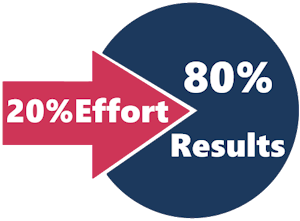
The Pareto Principle originates from the observations of Italian economist Vilfredo Pareto1 in the late 19th century. He noticed that roughly 80% of Italy's land was owned by 20% of the population. This pattern of uneven distribution appeared across various domains, from wealth and productivity to defects and outcomes. In the mid-20th century, quality management pioneer Joseph Juran recognized the broader significance of Pareto's insight and popularized it as a universal principle of imbalance, referring to it as the "vital few and trivial many".2 Over time, it was generalized into a heuristic: in many systems, a small number of causes are responsible for the majority of effects. In Agile contexts, this principle encourages teams to continually reassess where value is concentrated and avoid the trap of treating all work as equal. It invites product and delivery groups to challenge assumptions about effort allocation, prioritization, and stakeholder demand, especially in systems shaped by complexity and hidden dependencies.
Impact on Agile Organizations
This principle introduces both an opportunity and a risk. It offers clarity about high-impact effort, yet it can create blind spots if misunderstood or applied rigidly. When unexamined, teams may assume that identifying the top 20% is simple or static. Agile environments benefit from the adaptability that this principle encourages, but only when accompanied by regular feedback and reflection.
- Product Focus:
- Product Owners may use Pareto thinking to identify:
- Features that deliver the highest customer value.
- Customer types that drive the bulk of revenue.
- Defects that cause the most churn.
- Product Owners may use Pareto thinking to identify:
- Technical Debt and Refactoring:
- Teams often find:
- A small percentage of modules generate most bugs.
- A handful of design decisions cause most friction in development.
- Teams often find:
- Agile Metrics and Prioritization:
- Leaders may focus on:
- The few blockers that delay most deliveries.
- The small set of ceremonies or tools that generate most team friction.
- Leaders may focus on:
- Stakeholder Management:
- Engaging the right stakeholders can resolve the majority of alignment issues.
- Ignoring this risks over-collaboration and diluted accountability.
Scenario
A midsize product team was struggling to meet commitments and constantly juggling urgent requests. At each Sprint Planning, the backlog grew as stakeholders added more features. Over time, delivery slowed, morale dipped, and Retrospectives grew tense.
After a series of root cause workshops, the Product Owner plotted delivery outcomes and discovered that nearly 80% of customer-reported satisfaction came from just 15% of delivered features. Most other backlog items were barely used or quickly forgotten.
In this case, misunderstanding feature types led to misplaced priorities and ultimately user dissatisfaction. The Kano Model could have prevented this misalignment.
Key observations
- The most-used features were the ones with the most discovery work.
- The team was reacting to internal pressure, not external need.
- Technical complexity had crept in from low-value, high-effort initiatives.
This realization led to a turning point. By narrowing the backlog to strategic bets and enforcing a "validate before build" mindset, the team doubled delivery satisfaction and improved forecast reliability.
Ways to Mitigate Misuse or Misinterpretation
The principle should not be used to justify ignoring the long tail of needs. Many "20%" inputs that matter evolve over time. Agile teams should revisit value assumptions regularly and avoid overly deterministic models.
- Product Strategy:
- Use hypothesis testing to confirm what's truly high-value.
- Build measurement into features to validate usage over time.
- Technical Health:
- Apply Pareto analysis to codebase bugs, but balance with architectural foresight.
- Avoid starving "less visible" maintenance work that prevents future risk.
- Team Collaboration:
- Surface hidden work and feedback loops during Retrospectives.
- Prevent local optimization (e.g. for a single metric or role) from creating organizational debt.
- Portfolio Prioritization:
- Use Weighted Shortest Job First (WSJF) or Cost of Delay models to evaluate tradeoffs.
- Encourage leadership to focus not only on the 20% wins, but also on why the other 80% emerges.
Summary
The Pareto Principle provides Agile organizations with a valuable lens to focus energy and attention, but it must be applied with humility. Context changes. Value is not static. Teams grow when they learn to test where the 20% actually lies, not where assumptions place it.
- It sharpens prioritization but must be grounded in real data.
- It can improve morale when teams see high impact from less effort.
- It requires active conversation across roles to ensure balanced application.
- Pareto, Vilfredo (1896-1897). Cours d'Économie Politique (in two volumes). F. Rouge (Lausanne) & F. Pichon (Paris).
- Juran, J. M. (1951). Quality control handbook (1st ed.). McGraw-Hill.
Although Juran's first use of the concept dates to internal memos and training materials from 1941 at Western Electric, these materials are not publicly archived. The most widely recognized publication of the Pareto Principle as applied to quality systems appears in his 1951 Quality Control Handbook.