When given three options, people rarely choose the extremes - they gravitate toward the one that feels just right.
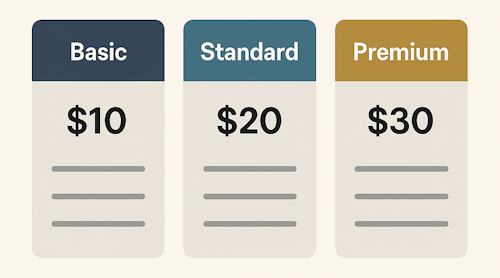
The Law of 3 refers to a simple yet powerful pattern in product design and consumer psychology: when given too many choices, users tend to hesitate, but when given too few, they may feel constrained. Offering three options (typically labeled as basic, standard, and premium) aligns with human decision-making tendencies. This structure helps users feel in control, compare meaningfully, and choose without cognitive overload.
This law has roots in behavioral economics and marketing psychology, where "three-tiered pricing" or the "Goldilocks principle" often results in the middle option being chosen most frequently. It also draws from usability research indicating that triads are cognitively digestible and perceived as offering sufficient variety without confusion.
Impact on Agile Organizations
In Agile product development, especially within customer-focused backlogs, the Law of 3 influences how features are prioritized, how interfaces are designed, and how value propositions are structured. Agile teams that understand this law are better positioned to:
- Simplify user choices in UI/UX.
- Avoid over-engineering with excessive customization.
- Shape product tiers or bundles to guide customer decisions.
However, ignoring this principle can result in feature bloat, decision paralysis, or misaligned user journeys - all of which slow down feedback loops and dilute customer value.
Scenario
An Agile team is building a SaaS tool for remote collaboration. Their Product Owner, eager to serve a broad market, suggests offering five distinct subscription tiers, each with granular feature differences. Early user feedback reveals confusion: customers struggle to choose a plan and abandon the signup process.
Ways to Mitigate Violations of the Law of 3
- Limit Customer-Facing Options:
- When designing interfaces or feature sets, resist the urge to present every configuration. Curate choices around clear personas or use cases.
- Use Middle-Option Anchoring:
- Structure offerings to make the central choice appear most reasonable, thereby guiding users toward your desired path.
- Apply in Prioritization:
- When presenting roadmap options to stakeholders, frame decisions as "three strategic bets" instead of dozens of backlog items. This supports Lean decision-making.
- Validate through Experimentation:
- Run A/B tests to compare user reactions to different option sets. Let behavior confirm or adjust the trio.
Summary
After applying the Law of 3, the team restructures the offerings:
- Free Tier: Basic messaging and file sharing.
- Professional Tier: Adds integrations, video calls, and limited storage.
- Enterprise Tier: All features, with admin controls and priority support.
The results show noticeable improvements:
- Simplified choice helps users commit faster, reducing hesitation during signup.
- Middle-tier adoption increases significantly, becoming the most popular plan.
- Support requests drop, as customers better understand what each plan includes.
- Product team focus improves, with clearer boundaries for feature development.
This shift demonstrates how applying the Law of 3 not only improves customer experience, but also streamlines Agile delivery and planning.