People don't buy what you do; they buy why you do it. 1
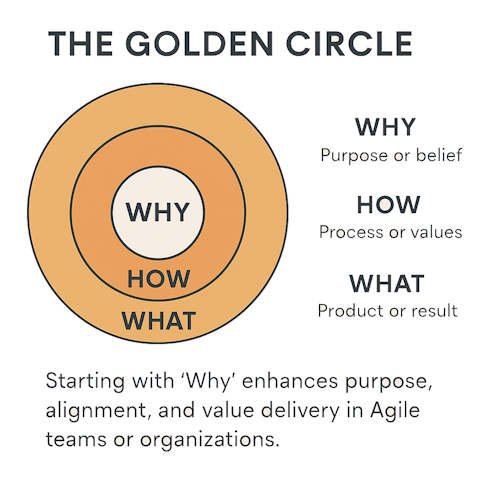
Simon Sinek's Golden Circle is a framework for inspirational leadership that has found resonance far beyond marketing or executive coaching. It centers on three nested questions: Why (purpose), How (process), and What (product). Agile teams and organizations that understand and align their work from the inside out, starting with Why, are better equipped to build shared meaning, navigate ambiguity, and deliver outcomes that matter. While Agile frameworks such as Scrum, SAFe, and LeSS often focus on iteration and delivery mechanics, the Golden Circle reminds us that high-performing teams start by anchoring their work to a compelling reason.
Impact on Agile Organizations
Agile transformations often falter when teams operate without a clear purpose. In the absence of Why, ceremonies become empty rituals, backlogs lose relevance, and velocity becomes a vanity metric. When the Golden Circle is ignored, teams tend to drift toward delivery for delivery's sake.
- Misalignment and Disengagement:
- Lack of clarity on Why causes confusion and low motivation.
- Teams focus on outputs (features) rather than outcomes (value).
- Surface-level Agile Adoption:
- Rituals are practiced, but without understanding or belief.
- Metrics become performative rather than diagnostic.
- Poor Stakeholder Communication:
- Without a unifying Why, communication fragments.
- The What gets micromanaged while the How varies without coherence.
Scenario
An organization has adopted Scrum across multiple teams but remains heavily roadmap-driven and reactive to shifting executive priorities. Developers often joke that they're building "whatever's on fire this week". Despite completing sprints on time, morale is low and customers feel disconnected from the product.
- Teams hold Retrospectives, but rarely raise deeper questions.
- Sprint Goals exist, but lack connection to a long-term vision.
- Leadership describes "Agile success" in terms of faster releases, not better outcomes
In this environment, agility becomes mechanical. Without anchoring around a shared Why, decision-making becomes tactical and short-sighted.
Ways to Mitigate
To integrate the Golden Circle into Agile ways of working, leaders and coaches should actively reconnect purpose with daily execution.
- Establish Why at all Levels:
- Product Vision: Clearly articulate the mission and who it serves.
- Team Purpose: Co-create a reason for the team's existence within the system.
- Reinforce the How with Intentional Practices:
- Define team working agreements that embody Agile values.
- Use Definition of Done and team charters to clarify process expectations.
- Make What traceable to Why:
- Story Mapping: Use journey maps and user stories to trace features to customer value.
- OKRs: Link Sprint outcomes to organizational goals.
- Facilitate Vertical Alignment:
- Use PI Planning and Reviews to reaffirm the Why across stakeholders.
- Encourage servant leadership that continuously checks alignment.
Summary
The Golden Circle is not a replacement for Agile frameworks, but a mindset amplifier. It helps Agile teams reframe their work around purpose, not just process. By focusing on Why, teams become intrinsically motivated and resilient to change. The Golden Circle supports clarity without rigidity and enables alignment without command. It elevates agility from a tactical implementation to a strategic posture.
- Sinek, S. (2009). Start with why: How great leaders inspire everyone to take action. Portfolio.