When we reduce the distance and increase the size of interactive elements, we respect the user's time and attention.
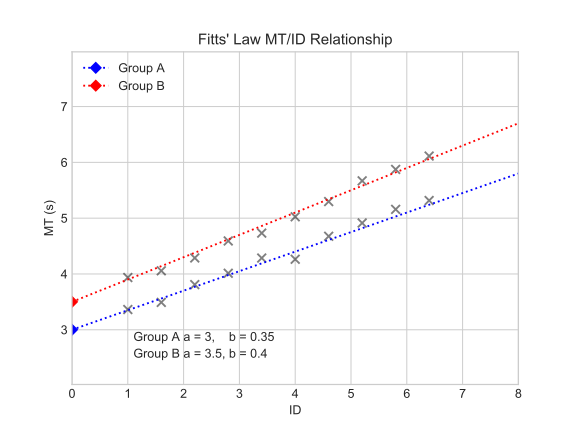
Fitts' Law, rooted in human-computer interaction research from the 1950s1, describes how the time to acquire a target is a function of both the distance to and size of the target. In other words, the closer and larger a clickable or actionable item is, the faster and easier it is to interact with. While often applied in the realm of interface design, the implications of this principle reach well into Agile product development, customer experience, and internal team workflows. Agile organizations benefit when they reduce cognitive and physical effort required to take action, whether it is a user clicking a button, a stakeholder engaging with a roadmap, or a team member navigating collaboration tools.
Impact on Agile Organizations
At its core, Fitts' Law reminds us that time and effort are tightly linked to ease of action. In Agile settings, this affects both external users and internal team efficiency.
- Product Usability and Customer Flow:
- Poorly placed or small call-to-action buttons hinder conversion.
- Cluttered interfaces with distant interactive elements increase friction.
- Designs that ignore proximity and scale lead to hesitation and errors.
- Team Tooling and Communication:
- Overly nested navigation in project management tools wastes team time.
- Critical workflow actions (e.g., tagging, assigning, committing) buried deep in UI flows reduce velocity.
- Large collaboration spaces with scattered access points can create decision fatigue.
- Agile Process Rituals:
- Retrospective input methods that require multiple clicks reduce participation.
- Information radiators that are hard to find or interpret get ignored.
- Feedback loops that are unintuitive delay learning and adaptation.
Scenario
An Agile team delivers a self-service dashboard for enterprise clients. It includes a feature for users to request support if they encounter issues. The button for this function is small, gray, and placed at the bottom corner of the page.
- Few users submit support tickets.
- The team interprets this as a success metric.
- Over time, churn rises, and NPS scores decline.
Eventually, user interviews reveal that customers struggled to find the support button and gave up. A redesign with a prominent, top-right "Need Help" button doubles the engagement rate overnight. The team learns that poor usability masked real needs.
This misalignment between actual and perceived usage delayed both support improvements and product enhancements. It also reveals the danger of misinterpreting silence as satisfaction.
Ways to Mitigate the Effects of Fitts' Law
Awareness of how physical and cognitive effort affects engagement can help Agile teams create more intuitive products and efficient workflows.
- Interface and Experience Design:
- Make key actions large, visible, and proximal to related content.
- Reduce distance between decision and action (e.g., placing "Save" near edited text).
- Use consistent placement across screens to reduce hunt time.
- Tool and System Optimization:
- Streamline workflows in Agile tools (e.g., fewer clicks to assign tasks).
- Customize dashboards to surface high-frequency actions.
- Minimize context-switching across apps during collaboration.
- Process Design and Team Rituals:
- Use visual cues and proximity in team boards (e.g., WIP limits shown inline).
- Make feedback mechanisms immediately visible and easy to trigger.
- Remove unnecessary friction in participating (e.g., emojis instead of typed comments during Retrospectives).
Summary
Agile teams are stewards of both product experience and team efficiency. Fitts' Law helps illuminate how small design choices can create large behavioral impacts. It calls us to look closely at the physical and cognitive mechanics of interaction, both for users and for ourselves.
- Good usability accelerates feedback and action.
- Hidden or distant controls reduce engagement and learning.
- Every additional click is a chance for someone to quit.
- Fitts, P. M. (1954). The information capacity of the human motor system in controlling the amplitude of movement. Journal of Experimental Psychology, 47(6), 381-391. https://doi.org/10.1037/h0055392