Observe - Orient - Decide - Act
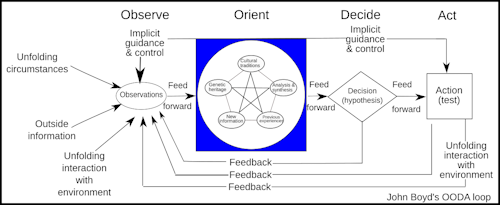
The OODA Loop1,2, developed by military strategist Colonel John Boyd, was originally created to help fighter pilots outmaneuver their opponents through a rapid cycle of decision-making. It stands for Observe, Orient, Decide, and Act. Over time, this model became a foundational concept in strategic thinking and agility beyond combat, particularly relevant in complex, fast-moving environments. Agile teams and organizations benefit from the OODA Loop by embedding its principles into iterative delivery, responsiveness, and decision-making under uncertainty.
Impact on Agile Teams & Organizations
The OODA Loop enhances organizational agility by reinforcing adaptability and speed of learning. Instead of rigid planning, teams focus on sense-making and real-time course correction. When teams fail to iterate quickly through the OODA cycle, they fall into reactive or static behaviors that lag behind change.
- Observe:
- Teams must gather information from customers, market conditions, metrics, and feedback loops.
- Without clear visibility, actions become misaligned or delayed.
- Orient:
- The most complex and influential step; orientation involves context-building, sense-making, and reframing based on mental models and shared understanding.
- Teams anchored to outdated assumptions or internal bias can fail to reorient even when signals are clear.
- Decide:
- Teams must choose a coherent direction based on what they observe and how they've interpreted it.
- Decision paralysis often results from over-analysis or unclear authority in Agile roles.
- Act:
- Execution completes the loop and generates new data for observation.
- Inaction or slow deployment breaks the feedback cycle and erodes agility.
Scenario
An Agile team supporting a digital banking platform sees declining usage on a new feature. Despite weekly Retrospectives and tracking analytics, they continue to optimize existing functionality without changing direction. The team operates under the belief that users simply need more time to adopt the feature.
- Their Observe step is limited to usage stats, ignoring qualitative customer feedback.
- Their Orient is clouded by an internal narrative that "customers always lag behind innovation".
- Decisions are minor UI tweaks, reinforcing their belief rather than challenging it.
- Actions are incremental and delay meaningful experiments that could yield new insights.
Over time, usage continues to drop. Meanwhile, a competitor ships a feature targeting the same user need but with a different experience and rapidly gains market share.
If the team had recognized the disconnect in the orientation step and looped faster through experiments, they might have pivoted early, preserving user engagement and learning in smaller feedback cycles.
Ways to Mitigate Misuse or Misalignment
Agile leaders and coaches can prevent stagnation in the OODA loop by creating the conditions for fast and informed cycling.
- Strengthen Each Phase of the Loop:
- Observe: Integrate qualitative insights (e.g., user interviews) alongside metrics.
- Orient: Use framing tools like Journey Maps or Cynefin to explore alternative interpretations.
- Decide: Create decision protocols and clarify ownership.
- Act: Timebox experiments and encourage frequent shipping over perfect solutions.
- Cultivate a Culture of Learning:
- Normalize revisiting assumptions in Retrospectives.
- Make "re-orientation" an explicit part of planning and review.
- Decouple Loop Speed from Delivery Speed:
- Some decisions need faster learning even if delivery remains paced; support spikes and discovery tracks.
Summary
The OODA Loop provides more than a tactical edge, it is a mindset of adaptive execution. Agile organizations that embrace it consciously are better positioned to thrive in ambiguity. What distinguishes high-performing teams is not just how often they deliver, but how quickly they make sense of the world, adapt their understanding, and act on it.
- Each iteration is not just delivery but a learning loop.
- Teams stuck in "decide and defend" rarely adjust their mental models.
- Orientation is often the bottleneck, not observation or action.
- Boyd, J. (1986). Patterns of Conflict.
- Boyd, J. R. (1987). A discourse on winning and losing [Unpublished briefing slides]. Retrieved from Defense and the National Interest Archive.