[A] thermostat that automatically turns on the heat whenever the temperature in a room drops below 69°F is a good example of single-loop learning. A thermostat that could ask, "why am I set to 69°F?" and then explore whether or not some other temperature might more economically achieve the goal of heating the room would be engaged in double-loop learning 1
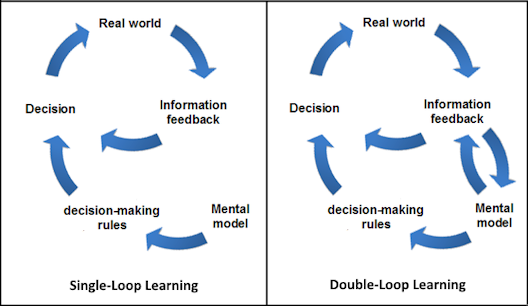
Double-Loop Learning is a concept introduced by Chris Argyris that goes beyond surface-level problem solving. In Agile environments, this model encourages teams and organizations not only to detect and correct errors, but also to examine and revise the underlying norms, values, or assumptions that led to those errors in the first place. While Single-Loop Learning asks, "Are we doing things right?", Double-Loop Learning challenges, "Are we doing the right things?" This mindset aligns well with Agile values of continuous learning, adaptability, and feedback-driven improvement, but it also presents a cultural shift that many organizations struggle to embrace.
Impact on Agile Teams & Organizations
The shift from Single-Loop to Double-Loop Learning creates a profound impact on how Agile teams reflect, adapt, and grow. It reframes Retrospectives from minor process tweaks to potential culture change.
- Increased Retrospective Depth:
- Teams begin questioning norms, not just behaviors.
- Facilitates breakthroughs in psychological safety and group maturity.
- Better Organizational Agility:
- Leaders challenge long-standing policies or assumptions when feedback loops reveal systemic blockers.
- Shifts focus from "better execution" to "better framing of problems."
- Sustainable Change:
- Teams move from reaction to proactive learning.
- Builds resilience by helping teams internalize how to change their own thinking.
Scenario
An Agile team consistently misses their Sprint goals. In their Retrospectives, they tweak estimation techniques and shift story point caps per developer. However, the problem persists. A Scrum Master suggests a Double-Loop learning lens:
- The team examines the assumption that scope commitments must match full capacity.
- They realize they've been optimizing for 100% utilization rather than sustainable pace.
- They explore why leadership pushes for exact utilization, uncovering a deep-rooted belief in efficiency over adaptability.
This shift changes not just planning mechanics, but also triggers broader discussions with leadership about success metrics.
The result: the team adopts a pull-based flow model, capacity buffer becomes normalized, and leadership begins tracking delivery rate trends instead of Sprint burnups alone.
Ways to Mitigate Resistance to Double-Loop Learning
Double-Loop Learning challenges identity, control, and hierarchy. Mitigating its difficulty involves working at multiple layers:
- At the Team Level:
- Normalize vulnerability during Retrospectives.
- Facilitate root cause analysis that explores "why we think this is the right way".
- At the Leadership Level:
- Introduce frameworks like Systems Thinking or Argyris's Ladder of Inference.
- Reward questioning of status quo, not just meeting objectives.
- At the Organizational Level:
- Bake learning loops into governance practices.
- Align KPIs with learning outcomes, not just delivery velocity.
Summary
Double-Loop Learning helps Agile teams and organizations transcend surface-level fixes and evolve how they think, decide, and define success. It challenges individuals and collectives to notice the water they swim in, their ingrained assumptions and invisible norms, and intentionally redesign them. For coaches, this means not just facilitating good Retrospectives, but enabling teams to self-reflect at the level of mindset and model. Organizations that cultivate Double-Loop Learning build resilience not by becoming perfect, but by becoming more adaptable in the face of change.
- Argyris, C. (1991). Teaching smart people how to learn. Harvard Business Review, 69(3), 99-109. https://hbr.org/1991/05/teaching-smart-people-how-to-learn.