High utilization kills speed. Flow beats overwork.
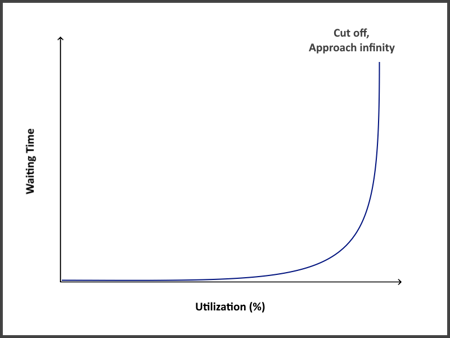
Kingman's Formula, derived from John Kingman's work in queueing theory1, provides insight into how variability in work arrival and service time affects lead time. It states that queue wait time (Wq) is influenced by utilization (ρ), variability in arrival rate (Ca2), and variability in processing time (Cs2) The formula can be expressed as:
\[ W_q \approx \frac{\rho}{1 - \rho} \times \frac{C_a^2 + C_s^2}{2} \times S \]
where:
- Wq = expected wait time in the queue
- ρ = utilization (arrival rate λ divided by service rate μ, i.e., ρ = λ / μ)
- Ca2 = squared coefficient of variation of arrival times
- Cs2 = squared coefficient of variation of service times
- S = mean service time
This formula is particularly relevant to Agile teams, where work items (e.g., user stories, bugs, and features) arrive unpredictably, and development times can vary. As teams approach high utilization, lead times increase exponentially, leading to bottlenecks, delays, and inefficiencies.
Impact on Agile Teams
- Increased Lead Time at High Utilization:
- As utilization nears 100%, any small increase in workload results in exponential increases in lead time, leading to delays in delivering value.
- Variability Affects Predictability:
- Agile teams experience variability in work arrival and effort estimation, impacting Sprint commitments and flow efficiency.
- Bottlenecks & Work-in-Progress (WIP) Issues:
- Overloading teams increases WIP, causing context-switching and inefficiencies.
- Reduced Responsiveness to Change:
- When teams operate at near-full capacity, they struggle to adapt to changing priorities.
- Quality and Morale Impact:
- High utilization and long queues lead to burnout, rushed work, and reduced quality.
Scenario
An Agile team working on a product is experiencing increased feature requests. They operate at 95% utilization, believing this maximizes productivity. However, work is taking twice as long to complete, and stakeholders are frustrated.
Observations
- Developers are constantly switching between tasks.
- QA finds defects late due to delays in feedback cycles.
- Stakeholders experience unpredictable delivery timelines.
Analysis Using Kingman's Formula
- Utilization (U) is too high, so lead time skyrockets.
- Variability in arrivals (Ca2) and processing (Ce2) makes forecasting difficult.
- The Backlog grows, and work queues become unstable.
Ways to Mitigate Kingman's Effect in Agile Teams
- Lower Utilization to Avoid Bottlenecks:
- Keep utilization below 80% to maintain stable lead times.
- Limit Work-in-Progress (WIP):
- Implement Kanban's WIP limits to control queue length and flow efficiency.
- Reduce Variability in Processing Times:
- Use techniques like pair programming, automation, and better refinement to stabilize effort estimates.
- Balance Demand and Capacity:
- Implement Capacity Planning in Sprint Planning to prevent overloading the team.
- Use Little's Law for Predictability:
- Maintain stable cycle times and batch sizes to ensure steady throughput.
- Prioritize and Smooth Work Arrival:
- Use a well-groomed backlog and buffer work intake to prevent variability in arrival rates.
Summary
Kingman's Formula reveals a fundamental truth: pushing a system to its limits reduces efficiency rather than increasing output. Agile teams should balance utilization, control variability, and limit WIP to maintain flow efficiency and predictable delivery.
- Kingman, J. F. C. (1961). The single server queue in heavy traffic. Mathematical Proceedings of the Cambridge Philosophical Society, 57(4), 902-904. https://doi.org/10.1017/S0305004100036094