The tendency for incompetence to prevent the recognition of incompetence.
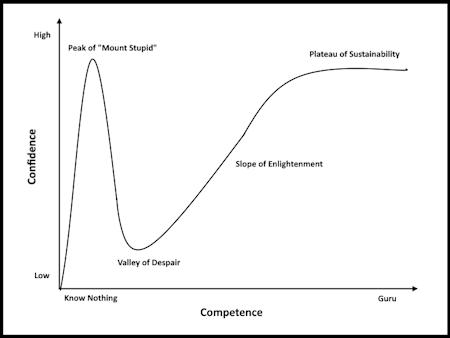
David Dunning and Justin Kruger, two social psychologists, first documented the effect in 1999.1 Their research showed that individuals with limited expertise in a particular area often lack the self-awareness to recognize their incompetence. As a result, they overestimate their abilities and make poor decisions. Conversely, highly skilled individuals tend to underestimate their own competence, assuming that tasks are easier for others than they actually are
In the context of Agile teams and organizations, this effect can significantly influence decision-making, team dynamics, and overall Agile adoption. Misjudgments of capability can lead to poor implementations of Agile practices, resistance to change, and challenges in fostering a culture of continuous improvement.
Impact on Agile Teams & Organizations
- Overconfidence in Agile Knowledge:
- Individuals or teams with superficial Agile knowledge might believe they fully understand Agile frameworks like Scrum or SAFe. This can lead to rigid implementations that miss the underlying principles of agility, resulting in ineffective or inefficient Agile adoption.
- Resistance to Feedback and Learning:
- Team members or leaders affected by this bias may dismiss Retrospectives, coaching, or training opportunities, believing they already possess all the necessary knowledge. This stifles growth and innovation.
- Poor Decision-Making in Agile Transformations:
- Organizational leaders who overestimate their understanding of Agile may drive top-down transformations without involving teams, leading to a lack of alignment, engagement, and ultimately failure.
- Impediments to Psychological Safety:
- Less experienced team members may be hesitant to challenge overconfident colleagues, leading to a culture where mistakes go uncorrected and inefficiencies persist.
Scenario
A traditional enterprise decides to transition to Agile. A senior executive, after attending a two-day Agile workshop, believes they fully grasp Agile principles. Without consulting trained and experienced Agile Coaches or teams, they mandate a rigid implementation of Scrum across all departments, expecting immediate results.
Challenges Faced
- Teams struggle because they are forced into Agile practices without proper training.
- The executive ignores feedback from teams, believing resistance is due to unwillingness rather than structural issues.
- Scrum Masters and Agile Coaches are sidelined, leading to a superficial Agile transformation rather than a meaningful cultural shift.
Resolution
An Agile Coach steps in to educate leadership on the iterative nature of Agile adoption, emphasizing learning and adaptation over rigid frameworks. Through workshops, coaching, and fostering psychological safety, the organization gradually embraces a more sustainable Agile transformation.
Summary
The Dunning-Kruger Effect can be a major barrier to Agile adoption and growth. Teams and organizations must recognize the importance of continuous learning, humility, and openness to feedback. By fostering an environment where individuals are encouraged to assess their knowledge realistically and seek improvement, Agile transformations can be more effective and sustainable.
- Kruger, J., & Dunning, D. (1999). Unskilled and unaware of it: How difficulties in recognizing one's own incompetence lead to inflated self-assessments. Journal of Personality and Social Psychology, 77(6), 1121-1134. https://doi.org/10.1037/0022-3514.77.6.1121